

Discussion on the Selection of Materials for the Shielding Layer of Cable Trays
A critical function of shielded cable trays is to protect the internal control cable signals from interference by electromagnetic radiation fields. Different materials and structures exhibit varying absorption rates for radiation interference; therefore, comprehensive consideration must be given to material selection, material structure, manufacturability, cost, and shielding effectiveness.
1. Frequency band analysis of radiation interference sources: Radiation interference primarily originates from three aspects: 1) Interference caused by lightning surges;
1) Electromagnetic interference generated by lightning discharge surges primarily occurs in the 1.5–2.0 kHz frequency range. 2) Environmental spatial radiation interference, such as that from microwaves, communications, broadcasting, and television, typically spans from tens of MHz to several GHz. 3) Close-range spatial interference arises when control signal lines and power supply lines are co-installed in the same space, resulting in two types: a) Low-to-medium frequency interference is predominantly induced, including interference below the tens-order harmonics (mainly current-induced) and electrostatic induction interference (primarily voltage-induced). However, induced interference requires two conditions: (1) parallel alignment with the affected signal line over an extended distance; and (2) proximity to the signal line (within millimeter-level proximity). This type of interference can be effectively mitigated by separating power supply lines from low-voltage conductors using partitions. b) Medium-to-high frequency interference is mainly electromagnetic radiation, with ultra-high-order harmonics generated by power supply lines serving as the primary source.
The above analysis shows that spatial radiation interference is predominantly in the medium-to-high frequency range, spanning from tens of megahertz to several thousand megahertz.
2. Adaptability of shielding materials with different structures: Shielding materials are categorized into two types based on their structure. The first type consists of closed structures such as membranes and plates-dense, cavity-free configurations. The second type features porous structures like mesh patterns. In porous structures, the pore diameter exhibits a positive correlation with the wavelength of interfering electromagnetic waves, meaning it is inversely proportional to the frequency of the interference signal. Consequently, mesh-pattern shielding layers are only effective against low-frequency electromagnetic radiation interference signals. For medium-and high-frequency spatial electromagnetic interference signals, dense shielding materials are required.
3. The shielding effectiveness is typically measured in decibels (dB). The electromagnetic absorption loss A of the shielding material determines the level of shielding effectiveness-the higher the absorption loss, the greater the effectiveness. The electromagnetic absorption loss is given by the following formula:
Calculation of Absorption Loss
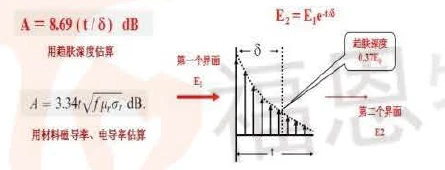
The shielding absorption loss of the material exhibits a positive correlation with 3.4 t (where t denotes the thickness of the shielding layer) and is positively correlated with the square root of the product of f (the frequency of the interference source), the conductivity μ of the shielding layer material, and the permeability μ₀ (with relative conductivities and permeabilities of copper both set to 1.0). Requirements for shielding effectiveness vary across different applications, ranging from 10–50 dB (i.e., blocking 90%–99.999% of electromagnetic interference signals) or even higher; specific values should be determined in accordance with applicable standards.
The above analysis shows that, in terms of shielding effectiveness, manufacturability, and cost, using metal films or plates as the shielding layer for cable trays is the optimal choice. This approach achieves a shielding efficiency of 40–60 dB (i.e., blocking 99.99%–99.9999% of electromagnetic interference signals) while offering excellent manufacturability and a favorable cost-performance ratio.